Cirifalco group from 1980
Official distributors of Rehlko Engines
From Italy to the global market, we supply customized internal combustion engines for OEMs and manufacturers seeking high performance, reliability and ongoing technical support.
in the world
OEM Engine Customizations
Spare parts
shop
Rehlko
Kohler
Lombardini Marine
Rely on a specialized team offering expert sales and consulting services for: Agricultural and industrial engines compliant with the emission standards of your country; Genuine spare parts from Lombardini and Kohler; Immediate availability: cut lead times and get exactly what you need, when you need it; Fast worldwide shipping: by land, sea, or air – your order delivered wherever you are.
International shipping? We’ve got you covered
The role of diesel generators in hybrid energy systems
How can an off-grid site maintain reliable power when solar production drops, batteries begin to discharge and the load still requires energy?
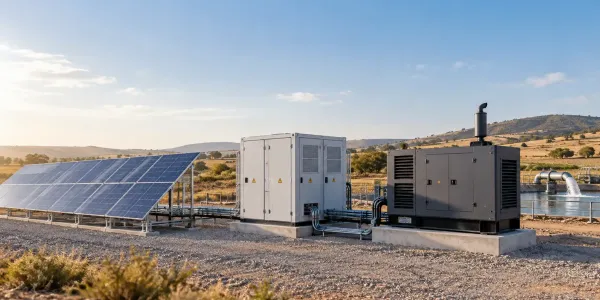
This is one of the central questions behind modern off-grid power systems. The discussion is often presented as a choice between conventional generation and renewables, but real industrial applications are more complex.
Diesel generators in hybrid energy systems can provide dispatchable power, while renewable sources generate energy when conditions allow and batteries manage the imbalance between production and demand.
The value comes from using each technology for a different purpose. Solar can reduce fuel consumption during daylight hours, batteries can store excess energy and manage load peaks, while the generator can operate when the other sources are not sufficient.
This approach is particularly relevant for construction sites, agriculture, telecom infrastructure, industrial microgrids, marine applications and remote facilities.
The real question is therefore not which technology should replace the others, but how generation, storage and backup can be combined to deliver reliable and efficient power.
Diesel generators in hybrid energy systems: not a diesel-versus-renewables debate
A hybrid energy system combines multiple technologies to supply the same load. A typical configuration may include solar PV, batteries, a diesel generator and an Energy Management System.
Renewable generation provides energy without consuming fuel during normal operation, but its output is variable. Solar power depends on irradiation and cannot guarantee the same level of production throughout the day.
Batteries help compensate for this variability. They can store surplus energy and release it when demand increases or renewable production decreases.
However, storage capacity is finite. If renewable production remains low for an extended period, the battery state of charge eventually reaches a critical level.
This is where the diesel generator performs a different function. It can be started when required and continue producing electricity as long as fuel is available.
The genset does not therefore need to be the primary source. In a well-designed hybrid system, it can act as dispatchable reserve power, operating only when the other sources cannot cover demand.
The objective is not to make every technology do the same job, but to use each one where it provides the greatest value.
Renewables, batteries and generators perform different functions
A typical operating cycle makes the interaction easier to understand.
During periods of strong solar production, PV can supply the electrical loads directly. If generation exceeds demand, the surplus can be used to charge the batteries.
As solar production decreases, the battery can supply the missing power without immediately starting the generator.
If high demand continues or renewable output remains insufficient, battery state of charge may fall below a predefined threshold. At that point, the Energy Management System can automatically start the genset.
The generator can then supply the active loads and, if required by the operating strategy, recharge the batteries at the same time.
Once battery capacity has been restored or renewable generation increases, the generator can shut down again.
In this way, diesel power is used only when necessary.
More advanced systems can also combine batteries and generators to manage peak loads, while the control system may consider weather forecasts, expected demand, battery state of charge and engine operating hours.
The result is a coordinated energy architecture rather than a competition between technologies.
A diesel generator can do more than provide backup power
Calling a diesel generator a backup source is often too simplistic.
Its first role is clearly to maintain power when renewables and batteries cannot cover demand. This is particularly important for critical infrastructure where interruptions may cause downtime, damage or loss of productivity.
The genset can also be used to recharge batteries. In some systems, it may be more efficient to start the engine, operate it within a favorable load range and use part of the generated energy to restore battery capacity.
Another function is peak support. Pumps, compressors and industrial equipment may require short periods of high power. Batteries and generators can work together to cover these peaks without oversizing the entire system.
A generator may also support black start, providing the initial power required to restart a microgrid following a complete shutdown.
These functions demonstrate why generator value should be assessed according to the overall operating strategy, not simply the number of hours it runs.
In many hybrid projects, the objective is to reduce generator runtime while preserving the security provided by dispatchable power.
Reducing fuel consumption without sacrificing reliability
One of the main advantages of hybridization is the possibility of reducing generator operating hours.
In a conventional off-grid system, a genset may remain running even when actual demand is well below its rated output. This can increase fuel consumption, engine hours and maintenance requirements.
With renewable generation and battery storage, the generator can remain off during favorable conditions and operate only when the energy balance requires it.
Batteries can also respond to rapid changes in demand, reducing the need for the engine to follow every short-term peak.
Lower engine runtime can reduce fuel consumption, extend maintenance intervals, limit fuel deliveries to remote sites and reduce local noise and emissions.
However, these benefits are not automatic.
A poorly sized hybrid system may result in frequent start-stop cycles, inefficient battery operation or extended genset operation at unsuitable loads.
The system must therefore be designed around the actual energy profile of the application, including load duration, peak demand, required autonomy and environmental conditions.
Generator sizing and control determine real efficiency
Generator selection in a hybrid system cannot be based on rated power alone.
Designers must consider the load profile, peak demand, transient behavior, battery capacity and the strategy that determines when the genset starts and stops.
An oversized generator may spend too much time operating at low load. A unit that is too small may struggle to supply active loads while also charging the batteries.
This makes the control system essential.
The Energy Management System decides when renewable power should be used, when batteries should charge or discharge and when the generator should start.
A basic strategy may start the genset when battery state of charge drops below a certain threshold. More advanced systems can also consider weather forecasts, expected demand, battery status and engine operating hours.
The efficiency of a hybrid microgrid therefore depends not only on individual component performance, but also on how those components are coordinated.
A successful hybrid system is based on the right balance between sizing, control logic and real operating conditions.
Where hybrid off-grid systems can create value
Hybrid power systems are useful in many environments where grid electricity is unavailable, unstable or difficult to extend.
Construction sites are a typical example. Power demand may change significantly as work progresses, and batteries, solar generation and gensets can be combined to reduce engine runtime without sacrificing power availability.
In agriculture, hybrid systems can support irrigation pumps, remote facilities and equipment located far from the grid.
Telecommunications is another important sector. Remote sites often require continuous power, while minimizing fuel deliveries and maintenance visits can significantly improve operating efficiency.
Mining, quarrying and other remote industrial applications may involve high loads, demanding environments and strict uptime requirements.
Marine systems can also benefit from the integration of traditional generation, battery storage and intelligent load management.
Finally, industrial microgrids may use hybrid generation mainly for resilience. The generator remains available as a safety layer when the grid, renewable sources or battery storage cannot meet the required load.
Across all these applications, generator selection should begin with the real operating profile, not simply with catalogue data.
The real question is not “diesel or renewables?”
Framing the discussion as diesel versus renewables can be misleading.
In a properly designed hybrid system, solar generation produces energy when the resource is available, batteries store energy and manage rapid load variations, while the diesel generator provides power when the other sources are not sufficient.
The result may be a system in which the genset operates far fewer hours than in a conventional off-grid installation, while remaining available when required.
The more useful question therefore becomes:
What combination of generation, storage and backup best fits the actual energy profile of the application?
There is no universal answer.
A construction site, a telecom station, an agricultural pump and an industrial microgrid all have different operating requirements.
Load profile, autonomy, environmental conditions, operating hours, maintenance strategy and system integration must all be considered.
In this context, a diesel generator is not necessarily an alternative to newer technologies. It can be one component of a broader energy system designed around reliability, efficiency and availability.
Cirifalco Group supports OEMs and industry professionals in the selection and configuration of engines and power solutions based on the real operating requirements of each application.
If your project is already under development, now is the right time to verify generator sizing, configuration and integration before reaching the final stage.
Contact us now: info@cirifalco.it
Euro 7 and industrial engines: why it is not a regulation to ignore in 2026
Lombardini engines for generators: why they have become strategic in critical and industrial contexts
Lombardini fire-fighting engines: certified reliability for pump sets and sprinkler systems