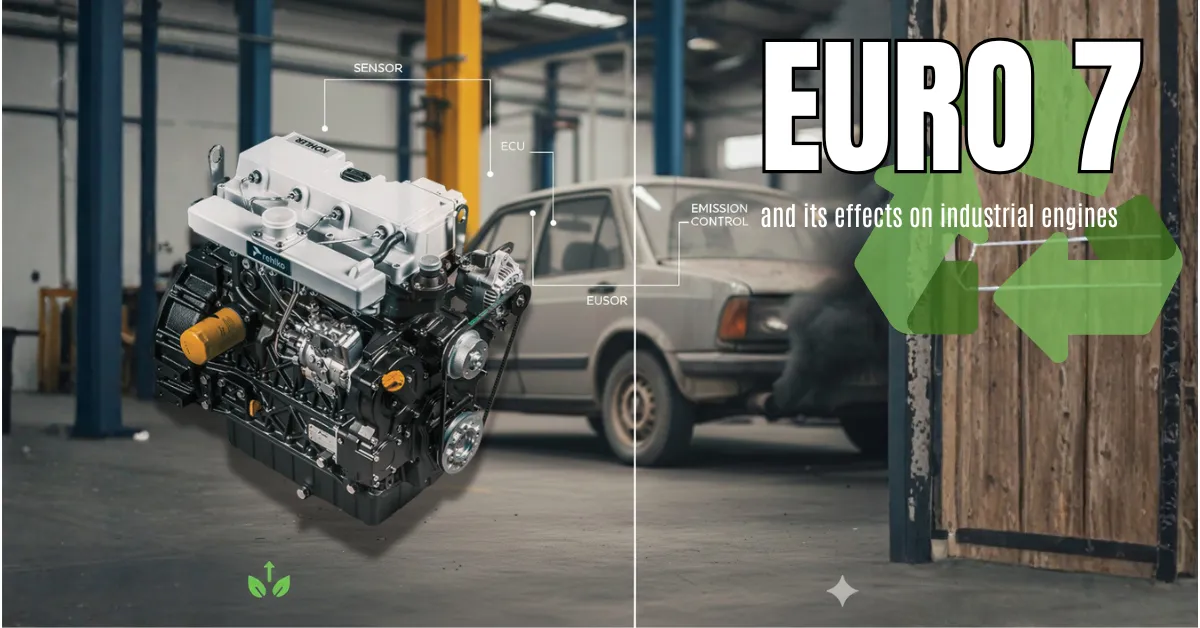
Euro 7 and industrial engines: why it is not a regulation to ignore in 2026
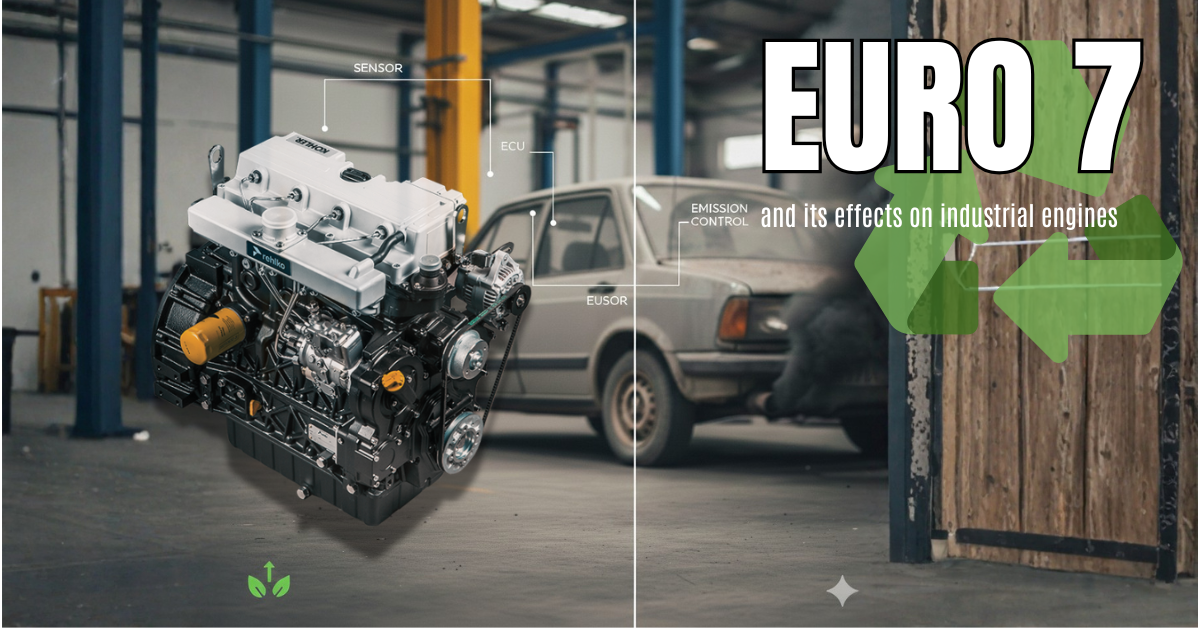
Euro 7 and industrial engines: discover what really changes in 2026 and the indirect impact on technologies, spare parts and OEM applications.
“Does Euro 7 also affect industrial engines and the spare parts we use every day?”
This is a question many industry professionals are asking at the beginning of 2026. OEMs, workshops, machine manufacturers and technical managers are increasingly hearing about Euro 7, stricter emission limits, new control systems and growing regulatory complexity. The doubt is legitimate: those working with industrial, agricultural or special-application engines want to understand whether this regulation will have a direct impact on their daily operations, installed engines, spare parts management and the skills required in workshops.
As is often the case in technical fields, the answer is not a simple yes or no. Euro 7 does not directly apply to industrial engines, but ignoring its effects would be a strategic mistake. The year 2026 represents a turning point, because this regulation is already influencing design, components, diagnostics and market expectations, even beyond the strictly automotive domain.
In this article, we clearly and practically analyse the relationship between Euro 7 and industrial engines, explaining what the regulation covers, why it does not directly apply to non-road applications and above all why it still represents a key trend for the engine and spare parts sector in 2026.
Euro 7 and industrial engines: regulatory differences that must be clarified immediately
When discussing Euro 7 and industrial engines, the first mistake to avoid is confusing different regulatory frameworks. Euro 7 is a European regulation designed for road vehicles, including passenger cars, light commercial vehicles, trucks and buses. Its objective is to further reduce the environmental impact of road traffic by introducing stricter limits not only on exhaust emissions, but also on particulate matter from brakes and tyres, as well as continuous emissions monitoring systems over the vehicle’s lifetime.
Industrial engines, such as those used in agricultural machinery, construction equipment, generator sets, motor pumps or non-road OEM applications, fall instead under the NRMM (Non-Road Mobile Machinery) category. For these applications, the relevant regulatory framework remains Stage V, which has been in force for several years and is still fully valid in 2026. To date, there is no official “Stage VI” regulation that replaces or complements Euro 7 in the industrial engine sector.
This means that a Stage V–compliant industrial engine does not need to be redesigned to meet Euro 7 requirements. Emission limits, test cycles and certification procedures are different. However, it would be a mistake to stop at this formal distinction. Regulations do not exist in isolated compartments: historically, developments in the automotive sector have influenced the industrial engine world as well, particularly from a technological standpoint.
In 2026, the real question is therefore not “does Euro 7 apply to industrial engines?”, but how the principles introduced by Euro 7 are already reshaping the environment in which manufacturers, spare parts distributors and specialised workshops operate. Understanding this distinction is essential to avoid underestimating a trend that, while not immediately mandatory, is clearly set to leave a lasting impact.
Why Euro 7 still influences the industrial engine sector in 2026
Even though Euro 7 does not directly apply to industrial engines, its impact in 2026 is indirect but tangible. Major engine manufacturers and component suppliers operate across multiple markets simultaneously: automotive, industrial, agricultural and power generation. This naturally leads to increasing technology sharing, common electronic platforms and integrated control solutions.
The technologies developed to comply with Euro 7 — such as more accurate sensors, next-generation ECUs, continuous emissions monitoring systems and advanced control strategies — do not remain confined to road vehicles. Over time, these solutions are adapted to industrial engines as well, especially in more advanced applications or in markets with increasingly strict environmental requirements.
In 2026, many OEMs are already requesting “future-ready” industrial engines, designed not only to meet current Stage V requirements, but also to be compatible with potential future regulatory developments. This means more electronics, more sensors, greater attention to diagnostics and improved traceability of engine performance over time.
From a spare parts market perspective, this trend is far from marginal. More complex engines require more specialised spare parts, higher technical expertise and more structured after-sales support. Even if the regulatory framework does not formally change, customer expectations do along with the level of professionalism required throughout the entire supply chain.
Euro 7 therefore acts in 2026 as a driver of innovation, pushing the entire sector towards higher standards, even where regulation does not yet impose them directly.
Impact on design, components and spare parts for industrial engines
One of the most visible effects of the relationship between Euro 7 and industrial engines concerns component design. Even without a direct regulatory obligation, many manufacturers are introducing solutions derived from the automotive sector to improve emissions control, engine reliability and durability.
This results in an increased presence of sensors, more advanced after-treatment systems, sophisticated electronic control units and increasingly complex engine management software. For those operating in the spare parts sector, 2026 marks an important transition: managing traditional mechanical components alone is no longer sufficient. Technical knowledge of electronics, diagnostics and system compatibility becomes essential.
From an operational standpoint, this means that:
- spare parts are becoming more specific and less interchangeable
- correct component identification is critical
- incorrect selection can lead to operational issues or non-compliance
For workshops and OEM manufacturers, the impact is equally significant. Maintaining modern industrial engines requires appropriate diagnostic tools and a deep understanding of control systems. In 2026, underestimating this aspect means risking being unprepared when facing engines that, while still Stage V compliant, increasingly adopt operating logics similar to those found in Euro 7 vehicles.
In this context, the role of the engine and spare parts distributor changes fundamentally: no longer just a product supplier, but a technical partner capable of supporting customers in component selection, installation and correct maintenance.
What this means for OEMs, workshops and manufacturers in 2026
From the perspective of OEMs and workshops, the topic of Euro 7 and industrial engines in 2026 is not theoretical, it is practical. Even without a direct regulatory obligation, the market is rewarding those who can anticipate change. Manufacturers designing machinery with industrial engines must consider increasing attention to emissions, performance traceability and long-term compliance.
For workshops, this translates into the need to invest in training and tools. Maintenance is no longer purely mechanical, but increasingly electro-technical. The ability to interpret data, fault codes and operating parameters becomes a real competitive advantage.
In 2026, anyone working in the industrial engine sector must therefore ask a key question: am I ready to manage increasingly complex engines, even if regulation does not yet force me to do so? The answer will make the difference between those who suffer change and those who use it as a lever for growth.
Why Euro 7 is a trend worth monitoring even for industrial engines
In conclusion, discussing Euro 7 and industrial engines in 2026 does not mean confusing regulations, but rather correctly interpreting industry trends. Euro 7 does not directly apply to industrial engines, but it is already shaping their future by pushing the market towards more advanced, controlled and sustainability-oriented solutions.
For OEMs, workshops and spare parts distributors, the message is clear: those who start understanding these dynamics today will be better prepared tomorrow. 2026 is not the year of a regulatory revolution for industrial engines, but it is the year when it becomes evident that the required technical level is rising.
And it is precisely in this context that expertise, technical support and the ability to interpret change become tangible value for the customer.
For a broader regulatory perspective, you may find it useful to read our in-depth article on engine emission regulations in 2025, where we explain which standards apply to industrial engines, non-road machinery and automotive applications across different markets.
👉 Engine emission regulations 2025: what rules actually apply